
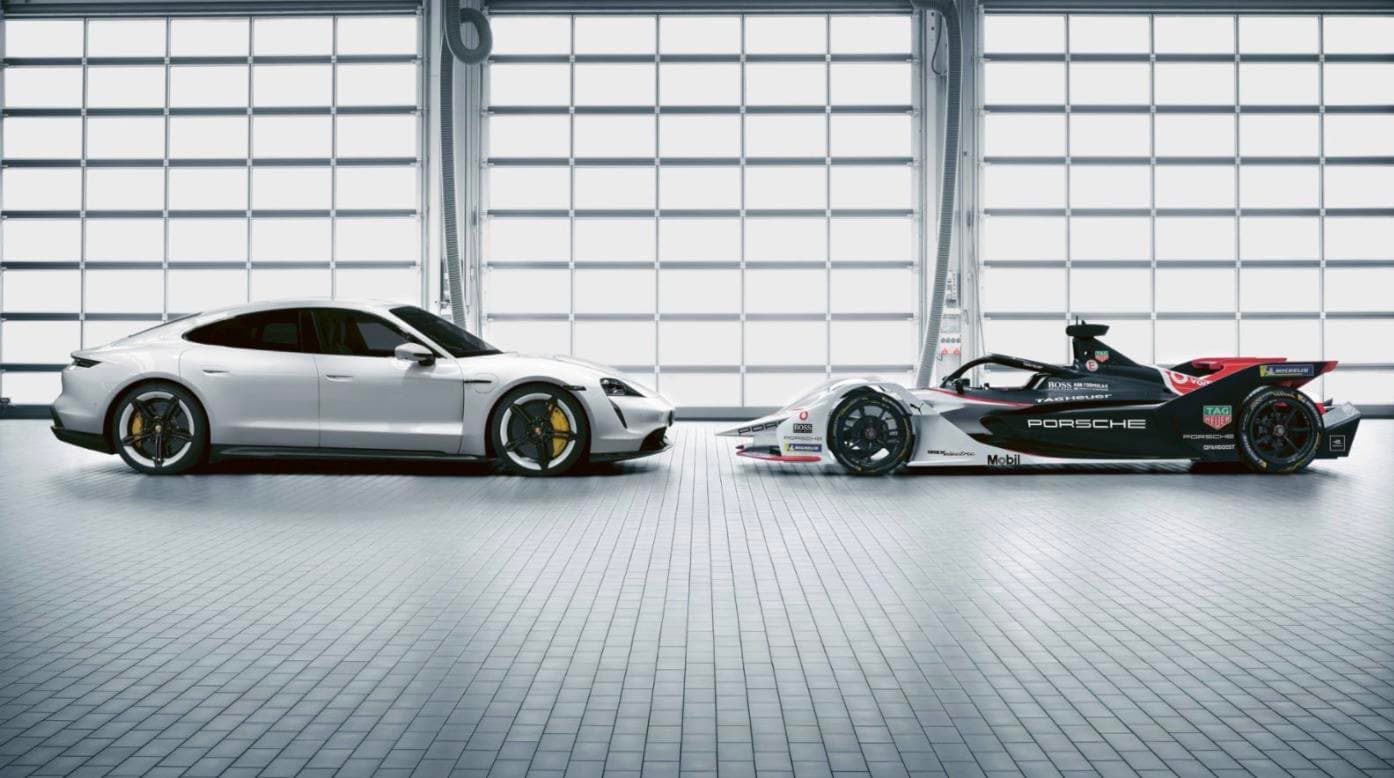
Porsche has seen highly innovative technical advances from motorsports to series production. Take the Porsche 99X Electric, for example. Propelled by the Formula E, this electric mover propels the race car from 0 to 100 km/h in just 2.8 seconds.
Martin Fuchtner, Senior Manager High-Voltage Drive Development, explains how Porsche’s mission is to win races, while “also pursuing a smooth transition to series production.”
The racing formula is intended to catalyze series production innovation, rather than serve as an exclusive technology reserve. While Formula E specifics standardized battery and vehicle chassis, the teams personally design the powertrain components. This includes differential, driveshafts, brake-by-wire system, transmission, electric motor, inverter, structural frame, and any associated suspension elements on the cooling system, control unit, and rear axle. What this does is level the playing field for teams with lower funding, as the teams do not need to design as many parts themselves. Additionally, the engineers can now primarily focus on the actual electric drive rather than investing their time and money into expensive secondary issues.
Currently, the main focus is honed in on two key components: the inverter and the electric motor. To drive the vehicle, the electric motor converts the alternating current into torque. Component weight needs to be reduced, and conductance losses along with internal eddy current need to be minimized. The team is greatly benefiting from already pursued research done by the Le-Mans prototype (LMP), which has discovered new materials and explored new motor topologies. Porsche has been massively pushing technology over recent years, allowing drive systems with under five liters volume to be capable of producing equivalent power to an entire sportscar engine.
Electric drive efficiency is also leveraged by adjusting the inverter’s switching pattern. The switching pattern is governed by highly complex mathematical algorithms that come down to even the minutest of changes affecting the race outcome.
Evidently, electric vehicles are no exception to Porsche’s crossover between motor racing and series production. In other words, the Taycan benefits from the lessons gained from the Porsche 919 Hybrid.
Categories:
News